Friday, April 2, 2021

The Problem with the Internet

The proverb runs:

"Surely in vain the net is spread in the sight of any bird."

    -yet for the most part we are not as clever as a bird.

***

To paraphrase some one much wiser than I:

"If service on the internet is free, you are likely the product being sold."

***

The problem with the internet is not Facebook, Twitter, or Google.  The problem is not liberal media bias or right-wing misinformation.  The problem is not corporate censorship or hands off governance.  


The problem is each of us.


We want to be acknowledged and liked.  Some trolls thrive mostly on conflict, but always on acknowledgement or validation.  

Facebook (and others) figured out how to exploit normal human psychological responses.  (Anyone remember Maslow's hierarchy?)  They make the most addictive brew of the posts of friends and acquaintances.  They monetize our screen-time on their respective platforms.  So the content is optimized to draw us in.  It is to morality and reason as refined sugar is to normal food.

Our problem is that we respond, we participate for a billion different reasons, yet we respond.  Individually as unpredictable as atoms, yet corporately we are as controllable as the temperature of a teapot.  

***

The answer to the internet of cancel-culture, hoaxes, twitter-mobs is the diffuse internet.  Avoid services that pander to your prejudices.  Test to see if what you have searched/watched/discussed becomes noticeable in advertisements.  If it does change platforms.  Change browsers.  Use smaller services.  If you must maintain contact with that special whomever, use a telephone, email, other services....  Find smaller servers and services.  Make your services discreet, and your acquaintances and curiosity broad.

If you are technically capable, stand up your own server.  If not, do what you can in the least encumbered manner.  Avoid monocultures.  

Further ideas accepted below for consideration.

Saturday, March 6, 2021

Book Stores: a few shards of reflection in a broken window

Book shopping, digging through the stacks, picking out one, turning over to survey, opening to scan and smell, moving on... is as physical and aspirational an occupation as working the dirt of a garden.  

December last year I and my youngest daughter went to a bookstore while shopping for presents.  Wandering the stacks and browsing books I realized that book shopping (not necessarily buying, certainly not just ordering online) was what had been missing from my Christmas preparations.  I then felt on some level emotionally ready for Christmas to come: the physicality of bookshopping had been fulfilled.

***

When we moved to this small town there was a bookstore in the mall.  A chain bookstore opened up with an espresso bar.  Then within a short time both bookstores closed.  There have been a couple of attempts at running used bookstores in town, but they have gone away also.

Now "local bookstore" means somewhere over an hour away.

Local physical stores of interest (by which I mean lots of used books):

The Grumpy Bookpeddler 

McKay's

***

Confession: Although physical bookstores are so much delight to to explore, I enjoy the convenience of online book shopping also.

Online sellers:

Amazon of course...

AbeBooks the eclectic side of the Amazon Organism

BookShop.org is new to me.  It seems to be benevolent but only things in the Ingram catalog are available for sale.  

Powell's I include somewhat nostalgically.  

***

Do you have any favorite bookstores or book shopping memories?

Friday, November 27, 2020

Life on the Wire

 The end of November is a good time to check your online security status.  This is no more paranoid than locking your car doors when in a big city.  

First have you been compromised?  Check your emails on monitor.firefox.com .  They aren't trying to fear-sell products as some of the functionally similar sites. 

  • Change passwords on any compromised accounts NOW.  
  • Don't reuse passwords.  
  • Do use a good password manager.

On password managers: I prefer offline password managers like KeePass, but a reputable online password management service is better than recycled or easy to break passwords.  I prefer offline because online password management services seem like a great negative opportunity for a data breach.  

Reduce your "attack surface".  That is:

  • Uninstall software you don't use.  
  • Close accounts for services you don't use.  
  • Unsubscribe from the junk emailers. 
  • Have a separate email account to use for junk/spam/...any place likely to sell your data to others. 
Do not fear.  Take responsibility for and control of your personal information.

Blessings.


Tuesday, November 10, 2020

A Kind of Solstice

 In some old calendars there was between the end of one year and the beginning of the new an undefined time, nameless time in the dark around solstice.

We are in such a time now: telling ghost stories of fascists and commies, sharing the fear of the unknowable to come by mapping it to the bojums and bandersnatchi of our grandfathers fears.

Once we have told our ghost story and sent the children off to bed (Is it any wonder that they have nightmares?) we check the door bolted. We sleep. We wake. We live life attenuated till the light increases.

Monday, October 19, 2020

Breakfast for the bold

 This morning after treadmill, shower and prayer I made masala oats for breakfast.  First had them from little instant packets from Patel's.  Here is my quick homemade style.


Prep:  I have chopped onion and chopped green peeper in separate plastic containers to make small servings easier.

***

Masala Oats - (PDRU approved)

In a small sauce pan saute on medium heat:

1 tablespoon butter (be generous)

a palm full of chopped onions (1/4 cup ish)

1 thin sliced cayenne or other warmth maker

Cook until onion go translucent... not brown.

Add and saute for 2 more minutes:

half as much chopped green peppers as onion

1 teaspoon garam masala

1 pinch salt


Add water and oats.  Continue cooking.

1-1/2 cup boiling water

1/2 cup quick steel cut oats  (or other type ...water/oat ratio....directions) 


This makes two small or one large serving which needs no other condiments.  Water and coffee recommended.  


Cook until done (three minutes for my quick steel cut oats).

Saturday, July 18, 2020

Linguistic Disfunction

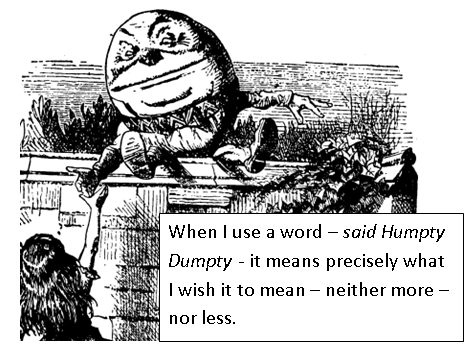
Humpty Dumpty Explains Glass-Steagall to Elizabeth Warren ...

I had an informative read this week followed by a coherent and related podcast.

First Things has an essay by Carl Truman entitled "Our Marcusan Moment".  In this eloquent piece was a link to a 1968 academic work "Repressive Tolerance".  The lead paragraph states:

THIS essay examines the idea of tolerance in our advanced industrial society. The conclusion reached is that the realization of the objective of tolerance would call for intolerance toward prevailing policies, attitudes, opinions, and the extension of tolerance to policies, attitudes, and opinions which are outlawed or suppressed. In other words, today tolerance appears again as what it was in its origins, at the beginning of the modern period--a partisan goal, a subversive liberating notion and practice. Conversely, what is proclaimed and practiced as tolerance today, is in many of its most effective manifestations serving the cause of oppression.

I urge you read both.

***
Done yet?

Ideologically loaded Humpty-Dumpty language lives.  My question is: to what end are these inversions of language directed?  

Is it just breeding resentment and dysfunction?  Destroying what currently is to allow to new utopia to be born?  A childish tantrum?

Honestly, to what end and is the end worth the destruction?

One discussion from an evangelical perspective is a podcast from HillFaith.blog which discusses Critical Theory with regard to our current cultural moment. 

***
Postscript:  I suspect that Marlon Brando's character in The Wild One was more honest than Marcuse.

Wednesday, January 22, 2020

Predictive Processing

I came across a review of the book "Surfing Uncertainty" by Andy Clark.  The review and subsequent comments were a good and challenging read. 

The key insight: the brain is a multi-layer prediction machine. All neural processing consists of two streams: a bottom-up stream of sense data, and a top-down stream of predictions. These streams interface at each level of processing, comparing themselves to each other and adjusting themselves as necessary.
 Two key ideas to catch: predictive processing and the concept of embodied cognition.  The complete review is at Slate Star Codex.  RTWT and comment please.