Showing posts with label religion. Show all posts

Thursday, September 21, 2023

How ought we worship?

      I went back home at the end of June from a few months of being where the Latin Rite was the norm—low Masses during the week, high Mass for Sundays and feast days. I came back to a normal bilingual Novus Ordo Mass. I understood much more clearly why people object to the bilingual approach, but also was struck at the chaos in that liturgy. It had escaped me before because it was familiar, but now—well, the jumps and starts were startling. It was exacerbated by the way in which instruments were being used, drums and synth were more clear than the human voices and an extra “punch” was frequently delivered by the synth at the end of any short line of prayer or song. (The priest was speaking all of his parts in English, while the choir was leading all responses in Spanish).

The Eucharist was given to people not just by the priest but also by a laywoman.

There were good things to say about the homily, the priest encouraged us to go after our “lost sheep”--those who were baptised but are no longer practicing the faith. Still, I could not go back. For Sunday Mass, I started going further to attend the Latin Rite.

    On the First Friday of July, I went to the local parish in order to go to Mass only to discover that there was no Mass. Some women were reading the readings for the day and leading some prayers. When one of them announced the Our Father “to prepare for the Holy Eucharist” I left. How was this different from Methodists or Anglicans? A priest consecrated the host ahead of time, but still, I could not bear it. I looked online for “First Friday Latin Mass” and found an evening Mass at an SSPX chapel. So I went. People were praying the Rosary when I arrived and presently Mass began. It was a low Mass, followed by prayers of reparation led by the priest. One of the people their handed me a booklet that had the prayers they were using. The Mass itself brought tears to my eye. I didn’t quite cry, I don’t think, but close. It is easier to pray there.

    Weekday mass at the NO comes a little closer to the simplicity of the low Mass, but the prayers are not as rich and you still have the jarring conversation thing happening. In the Latin Rite, I do not feel under any pressure to know and follow each genuflection and prayer, but rather an open and free invitation to participate in the great Prayer of the Mass, to enter mysteriously into the very life of Christ, to gaze into His holy Face and be enraptured in His most Sacred Heart. Doubtless, where the Creed is sung, I will sing along. If it is a high Mass, I will likely be singing along wherever more than one voice is singing the ordinaries. I will often be murmuring the propers in their places, or simply as I come to them while using the missal as a prayer guide—and what prayers!

    Since I mentioned the First Friday, here is an example from that day: “O God, You mercifully deign to bestow on us in the Heart of Your Son, wounded by our sins, an infinite treasure of love; grant, we beseech You, that, rendering It the devout homage of our affection, we may also make a worthy reparation for our sins. Through the same, etc.”

    Another example of the rich yet ordinary prayers of the Mass of the Ages is the reminder at every high Mass of our baptism as we are sprinkled with Holy Water and we sing the Asperges Me.

    Then there is posture—when the priest is also facing Christ in the tabernacle, when we are all facing East together it directs us toward God. When priest and congregation are facing each other—well it is easier to get caught on the horizontal and miss the transcendent.

    So far, this has only been my impressions, but the thing is, I know that God cares about how He is worshiped. He tells the Samaritan woman that God is to be worshiped in spirit and in truth (as well as telling her that the Samaritans did not know what they worshiped in contrast to the Jews). Throughout the Old Testament God is concerned with right worship. Cain was not happy because God preferred Abel’s sacrifice to his. Abel’s worship was accepted, Cain’s not so much. When Moses was sent to free the Israelites, it was so that they could worship God in the way that He was calling them to do. Along the way people died because they brought the wrong kind of incense or because they challenged the priesthood ordained by God. Is the God we worship, not the same today, yesterday, and forever?

Tuesday, October 18, 2022

Hello Again

 It has been too long since I have posted, perhaps.

This year is an odd year--I had the joy of going on a walking pilgrimage, the first pilgrimage I have been on.

The Pilgrimage for Restoration is an annual event that I learned of September of the previous year when visiting St. Peter and Paul Basilica down in Chattanooga.  I went to the website, read stuff, and ultimately decided to go.  A sister of mine came too, which made the going easier.  

I practiced setting up the tent, did not pray enough, neglected my Night Before setting off arrangements until  *too late*, and did not walk enough in preparation.  We did pack well, though, and had more than enough food.  When we arrived at Auriesville we got to meet the Brigadier for the Company of St. Joan of Arc, which was the company we would be marching/walking with.  We also met some of the Company of St Stephen of Hungary.  Delightful people all, and you know you are likely in good company when someone invites the group to pray the Rosary as we go along.

It was a good start to an amazing weekend of pilgrimage.  Quickly when we reached the camp at the Lake George Battlegrounds, we were meeting more of the Company of St. Joan and we were found a place to set up tent.  So many people have gone year after year, and so many people were new to the pilgrimage.  

Our tent was set up shortly before sunset, right behind a great statue of St. Isaac Jogues.  Now he was a worthy Jesuit.  Mass would be said in the morning on the other side of that statue.

After setting up the tent, with a little mishap along the way that was rectified by an unusual use of a seam-ripper, Elizabeth and I walked (and ran) down to the Lake of the Blessed Sacrament.  This was where St. Isaac Jogues landed.  It was kind of awe inspiring to think that here we were and within a few days, we would be were he and other Christian martyrs met their earthly ends.

In the morning, we got up before the dawn, dressed for the day and packed up the tent.  It was still dark when we formed up with our battalion to go to Mass.  We had been asked if we wanted to bear the standard.  A new old one had just been gotten, it had been retired by a parish in France, if I remember the story correctly.  On it was a representation of St. Joan of Arc bearing the banner.  Now, the problem with a novice bearing the standard is that we did not know where we were going.  We were pointed in a direction, moved confidently, and had to be redirected.  We made it to mass in any case, and still the sun was not yet risen.  

It was quiet.  A canopy was over the area of the Altar at the feet of the gigantic statue of St. Isaac Jogues.  A bishop was seated off to the side as mass was being offered.  We all faced God together.  As mass was being prayed, almost insensibly the morning dawned.  It was grey and then golden.  St. Isaac was more discernible, and with his mutilated hand raised in blessing, he was also a powerful reminder of the Faith.  The homily given also pointed to the example set for us by those martyrs of old.  We would be roughly following their path.  I hope, that when I die, however it may be, I die in the Faith, in the Love of God and get to be welcomed like them into heaven.


Saturday, July 18, 2020

Linguistic Disfunction

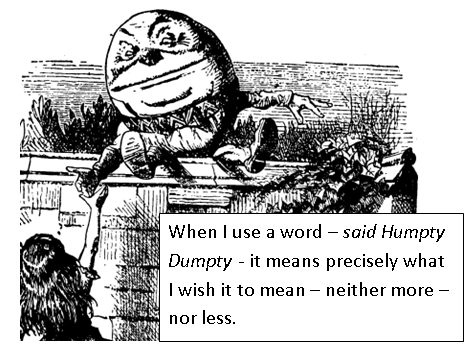
Humpty Dumpty Explains Glass-Steagall to Elizabeth Warren ...

I had an informative read this week followed by a coherent and related podcast.

First Things has an essay by Carl Truman entitled "Our Marcusan Moment".  In this eloquent piece was a link to a 1968 academic work "Repressive Tolerance".  The lead paragraph states:

THIS essay examines the idea of tolerance in our advanced industrial society. The conclusion reached is that the realization of the objective of tolerance would call for intolerance toward prevailing policies, attitudes, opinions, and the extension of tolerance to policies, attitudes, and opinions which are outlawed or suppressed. In other words, today tolerance appears again as what it was in its origins, at the beginning of the modern period--a partisan goal, a subversive liberating notion and practice. Conversely, what is proclaimed and practiced as tolerance today, is in many of its most effective manifestations serving the cause of oppression.

I urge you read both.

***
Done yet?

Ideologically loaded Humpty-Dumpty language lives.  My question is: to what end are these inversions of language directed?  

Is it just breeding resentment and dysfunction?  Destroying what currently is to allow to new utopia to be born?  A childish tantrum?

Honestly, to what end and is the end worth the destruction?

One discussion from an evangelical perspective is a podcast from HillFaith.blog which discusses Critical Theory with regard to our current cultural moment. 

***
Postscript:  I suspect that Marlon Brando's character in The Wild One was more honest than Marcuse.

Wednesday, August 30, 2017

Religion and Relationship


It’s not about religion, it’s about a relationship.” Have you seen that saying? Or maybe you have heard it; or both. I have heard it many times, and lately I pass this posted up on a church billboard. My first response, mental, but it IS also about what we BELIEVE, therefore, yes, it is “about religion” too. I may be reacting a bit, but I am a bit skeptical of anti-religious claims. Religion is hugely important. What we actually believe affects what we do, what we say. It would help ourselves and likely the people around us if we were more clear about what we believe and why.

So, what do you believe? Why do you believe it? Seriously, what stands at the core of your belief?
It is not that I came up with this question on my own. Some years back, my father asked his children this very question, challenging us to write it out. What do you simply accept, what is the undergirding, the foundation stones on which you rest everything else?


I started with, “God exists.”
I think I may have written about a page on just that, mostly copying scriptures. I did not continue writing out my beliefs, but that exercise in faith, reason, and belief had an impact on me. I realize that whether or not I fulfill my purpose in being, or even just understand it, God is God. He is and He is Good. I may never understand this world, but I am confident in that. Descartes began with, “I think, therefore I am,” and reasoned to the existence of a God outside himself. I am grateful for his reasoning, but must begin with God. He is our author.
I am a bit part in this play called life. I recognize that ultimately I hope to experience it as a traditional comedy—a story that ends well, has a happy conclusion. I recognize that along the way will be losses. I am not in control. I do get to choose how I act, though, and if I am sensitive to the Great Author’s promptings, maybe I will do the right things and say the right words at the right time. I am often slow. I am like the child who, after five rehearsals still does not even remember when it is her turn to step on the stage. How is it that God is still patient with me? I do not even know that, but I trust myself to his goodness and mercy because I believe.
This is my relationship with God. He calls. He opens my ears and mind and heart. I listen. He loves. I must love in return. “Must?” you might complain, but yes, “must” is the word. I do not understand how I could not love God. My earliest thoughts of him are connected to his death for me and because my sins. My earliest remembrance of him is connected to the Communion. “Why can I not eat and drink?” My mother explained what the bread and grape juice meant, that Jesus had died because of our sins to make us whole; that he rose again from the dead and wants to live in us so that we could be complete, we could inherit eternal life. I believed. Jesus loved me, enough to die for my sake. How could I not love him? I had to respond somehow, so I accepted his invitation to join him.  I would become his disciple, his daughter. When I turn to some sin that would separate me from God, he calls me by name.  When I would despair of ever "getting it right" he shows me one step and then another; one thing at a time, he teaches me.  It may take me three years to "get it", but he still continues to work with me. How can I not love him?
Is “it about relationship”? Yes, and it is also about religion. What I believe about God affects my relationship with God. What I believe affects what I say and do. I know a lot of what I believe.
Do you know what you believe? Do you know why?