Showing posts with label education. Show all posts

Friday, May 27, 2022

Prudence

As has been said elsewhere:

    When seconds count, the law enforcement is only minutes away.

Plan accordingly.

Saturday, July 18, 2020

Linguistic Disfunction

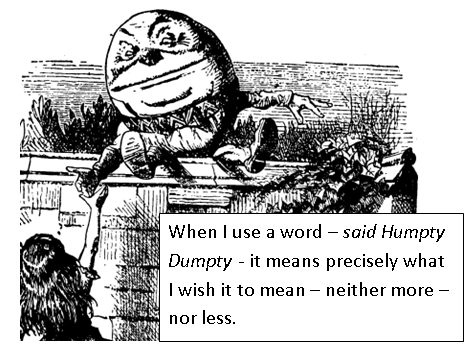
Humpty Dumpty Explains Glass-Steagall to Elizabeth Warren ...

I had an informative read this week followed by a coherent and related podcast.

First Things has an essay by Carl Truman entitled "Our Marcusan Moment".  In this eloquent piece was a link to a 1968 academic work "Repressive Tolerance".  The lead paragraph states:

THIS essay examines the idea of tolerance in our advanced industrial society. The conclusion reached is that the realization of the objective of tolerance would call for intolerance toward prevailing policies, attitudes, opinions, and the extension of tolerance to policies, attitudes, and opinions which are outlawed or suppressed. In other words, today tolerance appears again as what it was in its origins, at the beginning of the modern period--a partisan goal, a subversive liberating notion and practice. Conversely, what is proclaimed and practiced as tolerance today, is in many of its most effective manifestations serving the cause of oppression.

I urge you read both.

***
Done yet?

Ideologically loaded Humpty-Dumpty language lives.  My question is: to what end are these inversions of language directed?  

Is it just breeding resentment and dysfunction?  Destroying what currently is to allow to new utopia to be born?  A childish tantrum?

Honestly, to what end and is the end worth the destruction?

One discussion from an evangelical perspective is a podcast from HillFaith.blog which discusses Critical Theory with regard to our current cultural moment. 

***
Postscript:  I suspect that Marlon Brando's character in The Wild One was more honest than Marcuse.

Wednesday, August 30, 2017

Religion and Relationship


It’s not about religion, it’s about a relationship.” Have you seen that saying? Or maybe you have heard it; or both. I have heard it many times, and lately I pass this posted up on a church billboard. My first response, mental, but it IS also about what we BELIEVE, therefore, yes, it is “about religion” too. I may be reacting a bit, but I am a bit skeptical of anti-religious claims. Religion is hugely important. What we actually believe affects what we do, what we say. It would help ourselves and likely the people around us if we were more clear about what we believe and why.

So, what do you believe? Why do you believe it? Seriously, what stands at the core of your belief?
It is not that I came up with this question on my own. Some years back, my father asked his children this very question, challenging us to write it out. What do you simply accept, what is the undergirding, the foundation stones on which you rest everything else?


I started with, “God exists.”
I think I may have written about a page on just that, mostly copying scriptures. I did not continue writing out my beliefs, but that exercise in faith, reason, and belief had an impact on me. I realize that whether or not I fulfill my purpose in being, or even just understand it, God is God. He is and He is Good. I may never understand this world, but I am confident in that. Descartes began with, “I think, therefore I am,” and reasoned to the existence of a God outside himself. I am grateful for his reasoning, but must begin with God. He is our author.
I am a bit part in this play called life. I recognize that ultimately I hope to experience it as a traditional comedy—a story that ends well, has a happy conclusion. I recognize that along the way will be losses. I am not in control. I do get to choose how I act, though, and if I am sensitive to the Great Author’s promptings, maybe I will do the right things and say the right words at the right time. I am often slow. I am like the child who, after five rehearsals still does not even remember when it is her turn to step on the stage. How is it that God is still patient with me? I do not even know that, but I trust myself to his goodness and mercy because I believe.
This is my relationship with God. He calls. He opens my ears and mind and heart. I listen. He loves. I must love in return. “Must?” you might complain, but yes, “must” is the word. I do not understand how I could not love God. My earliest thoughts of him are connected to his death for me and because my sins. My earliest remembrance of him is connected to the Communion. “Why can I not eat and drink?” My mother explained what the bread and grape juice meant, that Jesus had died because of our sins to make us whole; that he rose again from the dead and wants to live in us so that we could be complete, we could inherit eternal life. I believed. Jesus loved me, enough to die for my sake. How could I not love him? I had to respond somehow, so I accepted his invitation to join him.  I would become his disciple, his daughter. When I turn to some sin that would separate me from God, he calls me by name.  When I would despair of ever "getting it right" he shows me one step and then another; one thing at a time, he teaches me.  It may take me three years to "get it", but he still continues to work with me. How can I not love him?
Is “it about relationship”? Yes, and it is also about religion. What I believe about God affects my relationship with God. What I believe affects what I say and do. I know a lot of what I believe.
Do you know what you believe? Do you know why?

Saturday, June 18, 2016

A passion for truth

     When I entered the room set aside for the seminar, there were not many people.  As more people began to come in, I enjoyed listening and observing.  There was a student who was not here because she had to, but was grateful that Franciscan hosted these conferences and that she had the opportunity to learn from the speakers.  There was a man in olive pants, tweed jacket, and slightly muddy shoes whom I judged to be a speaker.  Especially when the student who was messing with the sound equipment came up to him with a little clip microphone.  There was a student with maybe a German accent (I discovered that I was correct in that assumption later) behind me, talking about classes and theology and marketing.  I caught a glimpse of her dark, long coat and skirt, and bright blue scarf in my peripheral vision.
Most of the people on the first day seemed to be older than myself.  I overheard talk of coming from Pittsburgh and New York, but it did seem as though most people probably had some connection to Franciscan University.
     To start the conference, a priest was invited up to pray.  His eyes were mostly directed up, but were very lively and warm.  It almost seemed as though he was uncomfortable standing in front of the group.  But he prayed.  It was a very earnest prayer, not long; but just thinking back to his prayer--I do not remember any precise words--still as he prayed for the Holy Spirit to work amongst us and bless our efforts to bear to witness to the truth I felt like crying.

Then James Kalb was introduced and he did an excellent job of introducing all that was to follow.  It was a thick sort of discourse.  I am very glad I took notes, but I certainly plan to go back and do some reading, which is the idea of this sort of thing--whet people's appetites for what is true and good and beautiful, and they should then continue to pursue the true and good and beautiful.  I am afraid I do not do that enough as a teacher.  Anyway, back to the topic.
     One of the points that stood out in the first discourse was the idea of restoring a healthy understanding of Natural Law.  This was brought up as a way to confront the current technocratic approach to life and law.
What is technocracy? "the government or control of society or industry by an elite of technical experts." This definition exactly fits what Dr. Kalb was talking about.  Part of his complaint against the current liberal technocratic approach is that there is a tendency to disregard the voices of those not considered experts and expertise is increasingly defined by an increasingly atheistic humanist world-view.  What is reality is described as atoms, the void and sensation.  Also, there is a denial that they are exercising power.  They merely recognize the power and rights of every person, and act as arbitrators--the neutral protectors of everybody else.
So how do we respond?  Compromise?  Emphasize our traditions in terms of symbolism?  Emphasize functionality?  These are not adequate.  There is no compromise, because they see themselves as outside the debates about right and wrong--the "technical experts" inform us of what we need to do and if we don't understand, we must be ignorant.  Remaining loyal to tradition and defending it with symbolism and rhetoric only plays to their claim that traditionalists are illogical and narrow-minded bigots.  Functionality--well, how can we even begin to talk about function unless we agree that things are ordered to purposes?  This is where an understanding of natural law could really help.
We also need to have a renewed understanding of ultimate goods, the importance of sacrifice in society--our need for God.  We cannot merely tell the world that something is wrong; we must show them something better.  "Nothing is going to get better unless we get better."

I'm not sure if it was in answer to a question, but at the end of my notes on the first presentation was this, "Not anti-institutional
                      God, thinking, church, community
                                                                   Goal?  Christendom?"

One of the criticisms leveled against the technocratic world view is that it is reductionist, broadly-- figure out what the properties of a thing are in order to do what you want to do with it.  This stands against a more traditional approach of seeing a whole system of life that cannot necessarily be completely understood.

The next lecture was not delivered by the author as the author was ill.  While the first had been somewhat dense in information, technical, thoughtful, and engaging; the next was engaging in a very different way.

It had more of an element of anecdote--describing writing, looking out the window and remembering growing up as a "free-range kid."  He spoke of the sense of wonder in childhood that some grow out of, and some grow out of early on in their childhoods.  He spoke of the importance of wonder in accepting God and in seeing the world for what it is rather than what we can get.  He illustrated the idea of wonder and its opposite, excessive ambition, by the way of Shakespeare's Tempest.  Now, The Tempest is a familiar play to me, and one of my favorites by Shakespeare, but to hear it described in terms of wonder--think of all the magic and music of Prospero's island--made me want to revisit the play.  I would absolutely love to see an excellent presentation of it.

Another lecture that still stands out after a year was by Sheila Liaugminas, a journalist.  She spoke about the power of words and the importance of telling stories that tell truth.  In that, she also emphasized reading and writing from a heart centered on the ultimate Truth.

For a few little thoughts:
Nihilism--This word keeps cropping up as a word to describe the current situation of culture in the West generally and in the United States in particular.

Humpty Dumpty language and the LBGT movement--turning words inside out to insist that what is bad is good, what is wrong is right.

Objective good--a restoration of this idea being near impossible without the restoration of a right understanding of natural law, which also came up in various people's talks.

Ultimately, it comes back to a need to recognize who God is and what has He called us to be.
Sunday, May 3, 2015

Ideas

Ideas are important. Growing up, I was surrounded, for the most part, by people who had the same center to their ideas: Christ. I grew into that and accepted Christ as my own Savior, the center of all my ideas and beliefs. For a while, I did not encounter anything so different from that on a regular basis.
And then, I went to college. Now on an almost daily basis, I sit and try to learn in an atmosphere not Christ-centered for the first time. I find myself constantly on my guard and extremely hesitant to accept any ideas being taught without inspection because I do not want to integrate false and dangerous ideas into my belief system. I do not want to base my life on unstable and false ideologies. But, it's hard, and sometimes I feel like giving up and shutting down completely, not accepting anything. To try to find the truth and the good amidst the perverted and off-center curriculum constantly is tiring. I get angry at the statements that focus on irrelevant issues and forget the real problem. When the obvious truth may not be spoken for fear of offending someones sensitivities, I wonder if anything can or should be learned in this class. I have become more cautious, even to the point of cynicism, when certain topics are brought up.
In all this, I yearn to find a break from this in church. That is where I go to worship and fellowship with fellow believers, to be built up in Christ. However, I have become suspicious of everything I hear there as well. I have heard some statements, even from the mouths of trusted church leaders, in our local congregation and on the denominational level, that are...well, worrisome. As a younger Christian, I hesitate to criticize Christians who are older than myself. I believe God intends for younger folk to learn from the elders. However, when I hear statements that imply a doctrine that is blatantly anti-scriptural, it throws me into doubt and questioning. More than I would be afraid to learn some wrong theory about the brain, I would shrink from accepting any even potentially heretical theology. If I cannot trust church leaders, who are major instructors in the faith, who can I trust to teach sound, scriptural doctrine. Now, I realize that rejecting the church because of statements of a few people would be wrong. Christians are made to live in community as the body of Christ, not on individual little self-controlled islands. I am learning the (should-be-obvious) truth that God works through faulty people as He is working in them. They will not be perfect. The body of Christ is not yet perfected and God is working. I will not reject the church because of the faulty people in it. I happen to be one of them and unified is the only way the church will grow and improve.
But, back to ideas outside the church.
When I am participating in secular amusements like movie-going and other things, I have found myself struggling to enjoy them because of my concern about accepting any bad ideologies. I could simply separate myself entirely from anything secular to try to escape unsavory ideas, but, like I noted earlier, I would not be able to escape them all by running to the church, even though I would be in an atmosphere in which people would be (or at least should be) trying to learn and grow closer to God's truth. Currently, I know God has me where I am, going to college, studying psychology. In my studies I have confronted and will continue to confront faulty and even lethal ideologies. However, I have faith that God will strengthen me to be able to face them, weed out the truth from them, and be able to fight the lies.
Yes, ideas are important and good ones may seem hard to come by. But the most important thing is to keep God at the center of all ideas and beliefs. From there, everything else will come into line. When every idea, thought, belief system is measured according to God's truth, one will be able to tell what is good and what must be discarded as falsehood.